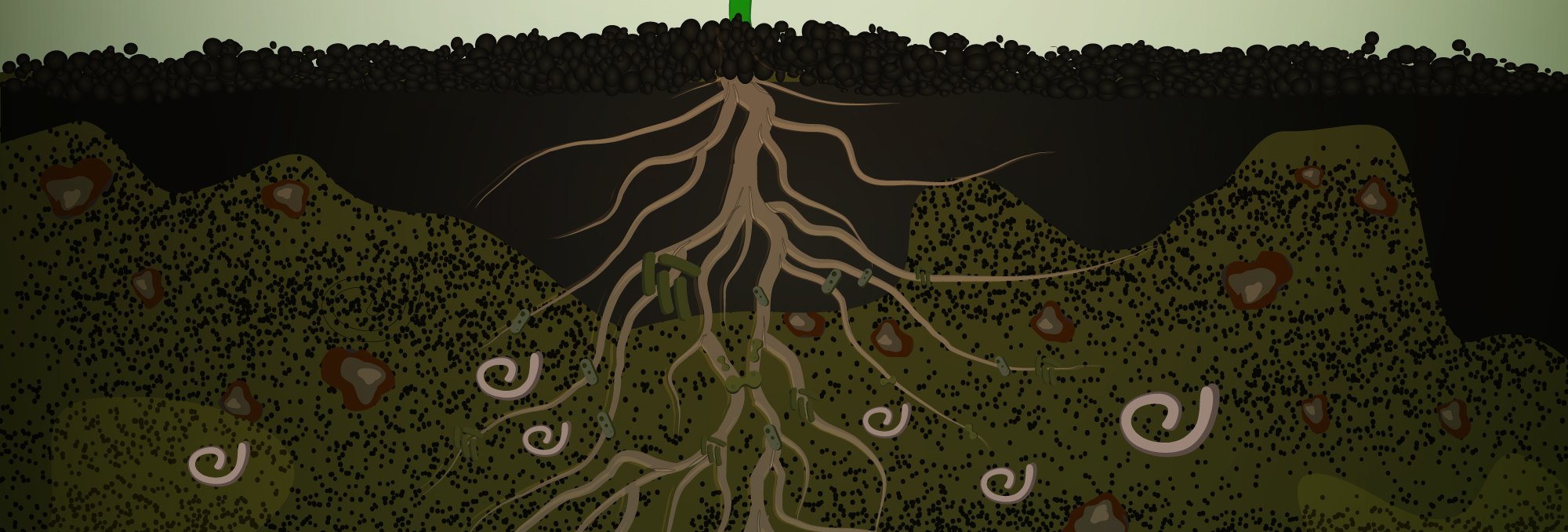
The development of diseases in agricultural crops and in general in any other biological system depends on the complex interrelationship between the host, the pathogen and the environmental conditions. Therefore, in the case of soil pathogens, it opens the opportunity for interactions with other microorganisms, which occupy the same ecological niche. For example, in the case of nematodes, the correspondence with the development of other diseases caused by other soil pathogens has been seen in many crops.
It is estimated to host a multitude of microorganisms, around 10⁶-10⁸ bacterial, 10⁶-10⁷ actinomycetes, 5 x 10⁴-10⁶ fungal colonies, 10⁵-10⁶ protozoa and 10⁴-5X 10⁵ algae, in others.
Many of these organisms are saprophytic, having little effect on agricultural crops, however, the moist soil environment is favorable for the activities of plant parasitic nematodes and for the growth and multiplication of pathogenic fungi. It is not surprising that a variety of relationships have been shown to exist between them.
Therefore, the development of the symptoms of a disease is often not determined solely by the responsible pathogen, but depends on a complex interrelationship between host, pathogen and the prevailing environmental conditions, as already stated. Furthermore, plants in the natural environment are rarely subject to the influence of a single potential pathogen. This is especially true in soil pathogens, where there is enormous interaction with other microorganisms that occupy the same ecological niche.
Plant parasitic nematodes cause severe crop losses worldwide and are among the most important agricultural pests. Managing nematodes is more difficult than other pests, because nematodes inhabit the entire soil and generally attack plant roots. Although nematicidal chemicals are generally effective, easy to apply, and quickly demonstrate effects, they have begun to be withdrawn from the market in some developed countries due to environmental health and safety concerns. The search for novel and environmentally sustainable alternatives for the management of plant-parasitic nematode populations has become increasingly important.
A viable alternative arises from the fact that nematodes in soil are subject to bacterial and fungal infections. Bacteria are numerically the most abundant of the organisms in soil. In the last twenty years, extensive research has been carried out to evaluate its potential to control plant parasitic nematodes. In these research efforts, it has been found that nematophagous bacteria are widely distributed, have diverse modes of action, and have wide ranges of action. A variety of nematophagous bacterial groups have been isolated from soil, host plant tissues, and from nematodes and their eggs and cysts. And it has great potential since they affect nematodes in a variety of ways: for example, parasitizing; producing toxins, antibiotics or enzymes; interfere with the nematode – plant-host recognition; competing for nutrients; Induce systemic resistance of plants; and promote plant health.
The group of rhizobacteria to which a large group of bacteria from the LIVENTIA portfolio belong, such as: Bacillus sp, Lysinibacillus sp Microbacterium sp, Alcaligenes sp and Arthrobater sp. They have also been studied for the control of plant-parasitic nematodes, and are among the dominant populations in the rhizosphere that can combat nematodes. Rhizobacteria reduce nematode numbers mainly by regulating the behavior of nematodes in plant recognition, competing for essential nutrients, promoting plant growth, and inducing systemic resistance.
References:
Gottlieb D, 1976. Production and role of antibiotics in soil. Journal of Antibiotics 29, 987–1000.Wallace HR, 1978. The diagnosis of plant diseases of complex etiology. Annual Review of Phytopathology 16, 379–402.Koenning SR, Overstreet C, Noling JW, Donald PA, Becker JO & Fortnum BA (1999) Survey of crop losses in response to phytoparasitic nematodes in the United States for 1994. J Nematol 31: 587–618.Schneider SM, Rosskopf EN, Leesch JG, Chellemi DO, Bull CT & Mazzola M (2003) Research on alternatives to methyl bromide: pre-plant and post-harvest. Pest Manag Sci 59:814–826.Siddiqui ZA & Mahmood I (1999) Role of bacteria in the management of plant parasitic nematodes: a review. Bioresource Technol 69: 167–179.